Key Question
Can Canada meet the Paris Agreement carbon dioxide reduction targets?
Theoretically, but no government, Liberal or Conservative, has done so because of the damage it would cause to public services, well-being and the economy.
The cost for Canada to meet its Paris Agreement target of a 30% emissions reduction from 2005 levels by 2030 is easily a trillion dollars, although exact figures are impossible to determine. The cost would be the sum of three factors:
1 – the cost of all the federal, provincial, municipal, and other actions to reduce greenhouse gases (GHG) to date. This has been going on for decades, and there is no comprehensive list of these programs available, let alone the total cost of them. At the federal level, for example, Canada has been setting GHG emission reduction targets, and implementing emission-reduction measures, since 1992. It is reasonable to assume the amount spent to date by government greatly exceeds $100 billion.
2 - the cost of continuing many of the existing measures until 2030, plus those already approved (existing plus approved policies is referred to as “promised policy”). Again, the cost is unknown because no complete listing of these programs has been assembled, let alone their total cost tabulated. It is reasonable to assume the amount to be spent by 2030 by governments at all levels exceeds $100 billion.
3 - the cost of measures that will need to be taken to address what has been called the “Paris Gap.” This is the amount that must be spent to bring Canada’s overall GHG emissions down from what would occur in 2030 as a result of promised policy to Canada’s actual target level of 30% below 2005 levels. The magnitude of the Paris Gap is huge, estimated at 112-megatonne (MT).
Unlike the first two costs, some good numbers have been published concerning the Paris Gap price tag.
In “Mind the (Paris) gap: The economic impact of the Paris commitment on Canada,” published on July 13, 2020 by the Alberta-based Canadian Energy Centre, it was found that closing the Paris Gap would result in:
- A reduction of investment in Canada of $19.2 billion in 2030 alone, the vast majority of the reduction being outside of Alberta. This represents a reduction of 5.2% below the investment in Canada that is expected to occur in 2030 if only current and proposed policies are continued. Much of this reduction occurs as a result of real investments in 2030 in the mining, refining, and oil extraction sector in Canada dropping from $68.3 billion to $57.8 billion, a reduction of $10.5 billion or 15.4%.
- A doubling the federal carbon tax from $49.15 per tonne in 2025 (it is currently $30) under the “Promised Policy” case to $116.02 per tonne by 2030 for Canada to meet its Paris commitment.
- GDP will be $54.0 billion less in Canada in 2030 than it would under the promised policy case.
- Real Canadian oil and gas sector GDP will be about $6.8 billion, or 7.8% less, if the Paris Gap is closed. This is approximately equivalent to Ontario’s motor vehicle manufacturing sub-sector which employed 37,658 Ontarians in 2019
- There will be 300,000 fewer full-time equivalent jobs in Canada. This loss is more than the total number of people employed in Newfoundland & Labrador and and PEI combined (2019).
The Friends of Science Society (FOSS) summed up the situation well in this video.
This is precisely why no government to the present has come even remotely close to meeting their promised targets.
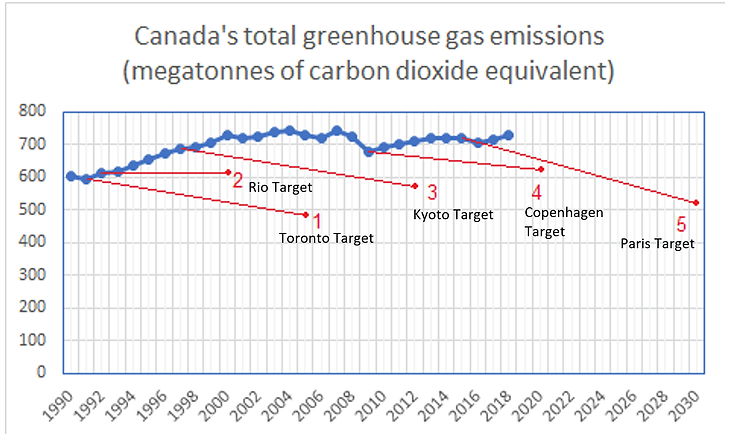
Here are the targets, and the results. See the graph further down the page for a visual representation of what was promised (numbers indicate targets in the following list) and what actually occurred.
- Between 1984 and 1993: Prime Ministers Trudeau, Turner, Mulroney, Campbell and Chretien committed to reduce emissions to 20% below 1988 levels (588 Mt CO2e) by 2005. Indeed, this was the target Canada agreed to at the 1988 Toronto Conference on the Changing Atmosphere. Instead, our emissions rose about 24% between 1988 and 2005.
- 1992: Canada targets year 2000 as having the same GHG emissions as in 1990. This was Canada’s target under the 1992 Rio de Janeiro Earth Summit. Instead, emissions rose about 21% above 1990 levels by 2000.
- Between 1993 to 2006: Prime Ministers Chretien, Martin and Harper pledged to reduce to an average of 6% below 1990 levels between 2008 and 2012. Eddie Goldenberg, Chretien’s top political aide admitted in 2007 that the Liberals knew they had no way of implementing the target when Chretien signed the Kyoto Protocol which included those targets. Instead, in 2012 emissions were 18% above 1990 levels.
- 2009: Harper pledged to reduce GHG to 17% below 2005 levels by 2020. This was Canada’s target under the Copenhagen climate agreement. University of Alberta School of Business Prof. Andrew Leach said at the time that would require the government to shut down the equivalent of Canada’s transportation sector within a decade. Instead, emissions were about the same in 2018 as they were in 2005.
- 2015: Harper pledged to reduce GHG emissions to 30% below 2005 levels by 2030. This was Canada’s target under the Paris Agreement and is the current target of the government of Justin Trudeau. We are on track to emit 112-megatonne more than the target with current and promised policies.
How You Can Help
Holding policymakers accountable for harmful decisions is essential to ensuring transparency and fostering trust in our institutions. By supporting accountability measures, we create pressure for better governance and evidence-based policy making.
Find and promote Canadians worth supporting.
This is an unpopular issue, but one with huge follow-through. Staying informed about climate science policy ensures you understand the real stakes and can cut through misinformation. Knowledge is power when it comes to driving meaningful action.
Maybe we can help.
Engaging directly with businesses, institutions, and community leaders amplifies the call for a better future. Your voice as a constituent, customer, or community member carries weight in driving organizational change.
Engage with some fellow pathfinders.
Working within your political party to push for better policy creates change from the inside. Party members who advocate for evidence-based climate action help shift the conversation and influence platform decisions.
Help us hold the line.
Questions From Climate Skeptics
Have a different question and can’t find the answer you’re looking for? Reach out to us by sending us an email and we’ll get back to you as soon as we can.
- Adaptation, Prosperity, and Environmental Stewardship
Given the uncertainty of climate science and the unsoundest of proposed migrations, it our responsibility to demand accountability.
Learn more- Do most climate experts agree that we face a climate crisis?
Some certainly do, but there remains a wide range of scientific analysis about the causes and consequences of climate change.
Learn more- Is anything unusual happening?
Maybe, for although modernity isn't historical the recent climate changes do fall within natural variability.
Learn more- Do we need to worry about carbon dioxide?
Maybe, but carbon dioxide being mostly plant food. Calling it 'carbon pollution' is political and not scientifically based.
Learn more- Can we forecast climate?
Not accurately, models make assumptions about a complex system so their forecasts remain unreliable at this time.
Learn more