Key Question
Are temperatures rising?
It has warmed just over one degree Celsius since 1880 when the Little Ice Age was ending. However, we are actually in one of the coldest periods in Earth's history.

Dozens of people have attempted to reconstruct the Earth’s temperature history using a wide variety of evidence or indicators over geologic time of hundreds of millions of years. None can be said to be perfectly accurate, but all recognize the coldest periods with ice covering much of the planet, to the warmest periods of dense vegetation when the dinosaurs roamed the Earth.
In 1950, according to NASA's Goddard Institute for Space Studies, the mean surface temperature of the Earth was 14 degrees centigrade (C), which is 57 degrees Fahrenheit (F). During the last 420,000 years it varied from a low of 5C/41F to a high of 17C/63F, a range of 12C/22F.
Toward the bottom of the range it was cold enough for glaciers to increase in size, and toward the top, it was warm enough for them to melt. The colder years are referred to as ice ages and the warmer years as interglacials.
Current climate scientists have attempted to simulate the Earths’s climate with mathematical equations which contain the variables they believe to be the most important drivers of our planet's temperature. They do this while ignoring factors they know little about, yet common sense would make one believe them to be important. These include:
- Seasonal changes in the Sun's radiation
- Energy flows from ocean to air and oceans to land
- The balance between Earth's water, water vapor and ice
- The impact of clouds
- Mass changes between sea level, ice sheets and glaciers
- The role of vegetation
- Tectonic movements on the ocean floor
- Differential movement of the earth’s crust and its molten core
Perhaps even more important is that they ignore the known variables regarding our solar system. Over the history of the Earth, its temperature has varied over thousands of years due to its location in the solar system, a variation that is greater than most people recognize.
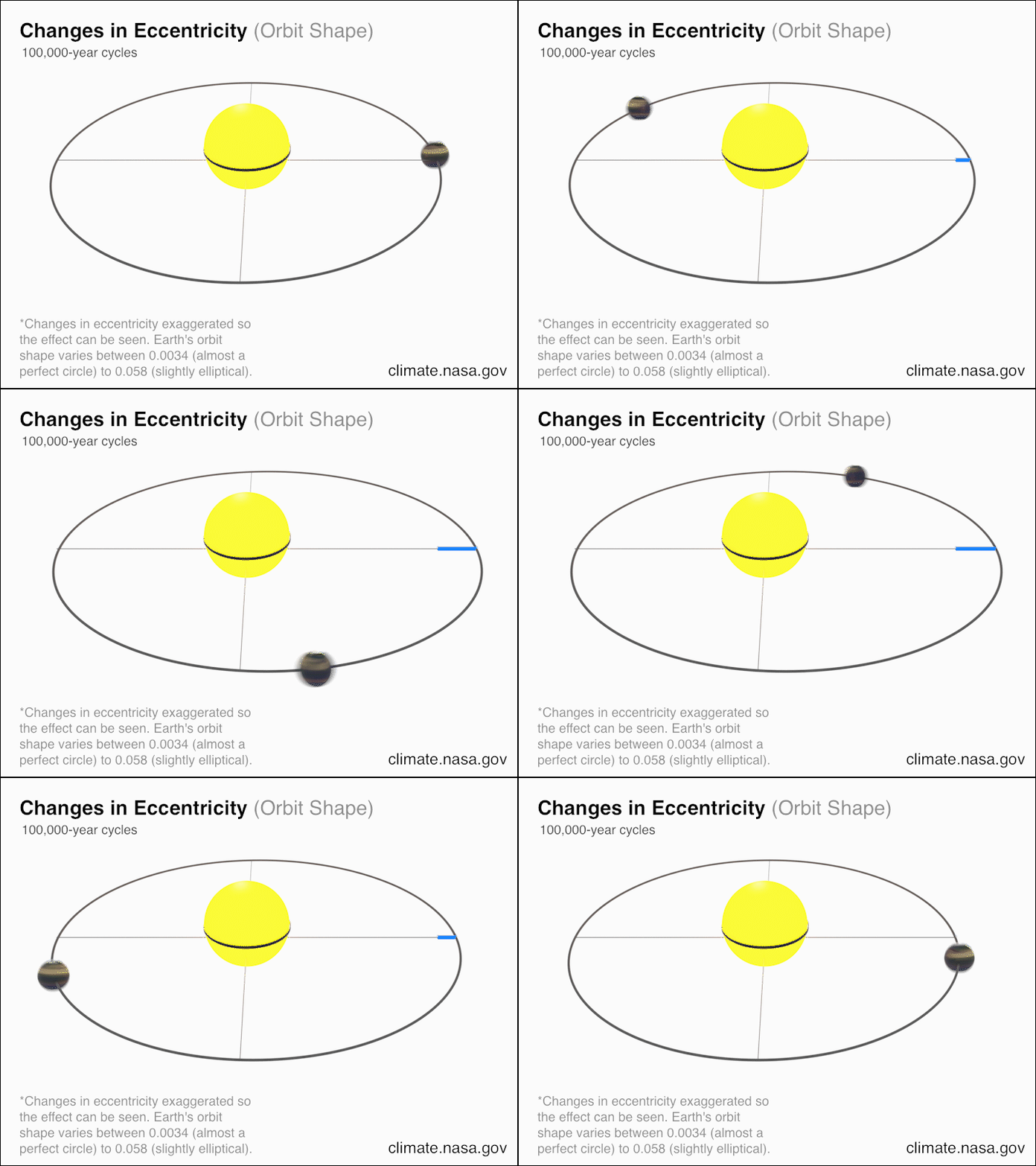
The Earth's orbital path around the Sun varies its eccentricity every 100,000 years, changing its distance from the Sun from 83 to 120 million miles. Currently, as you learned in grade school, we are 93 miles away. Obviously, the closer we are the warmer the Earth is, and vice versa.
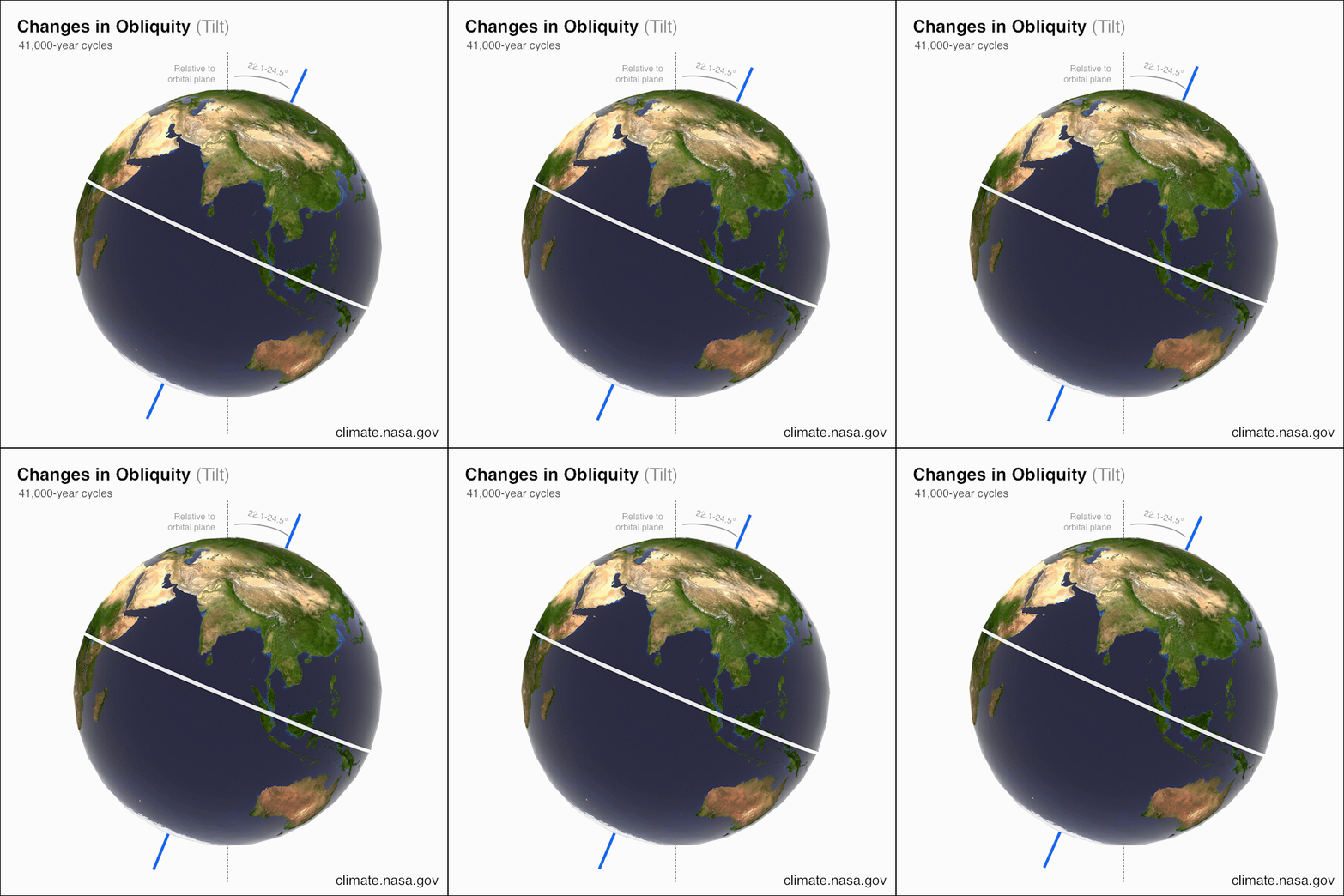
A second major factor is that, over every 41,000 years the tilt of the Earth on its axis varies from 22.7 degrees to 24.5 degrees altering its seasonal climate. The inclination is now 23.7 degrees.
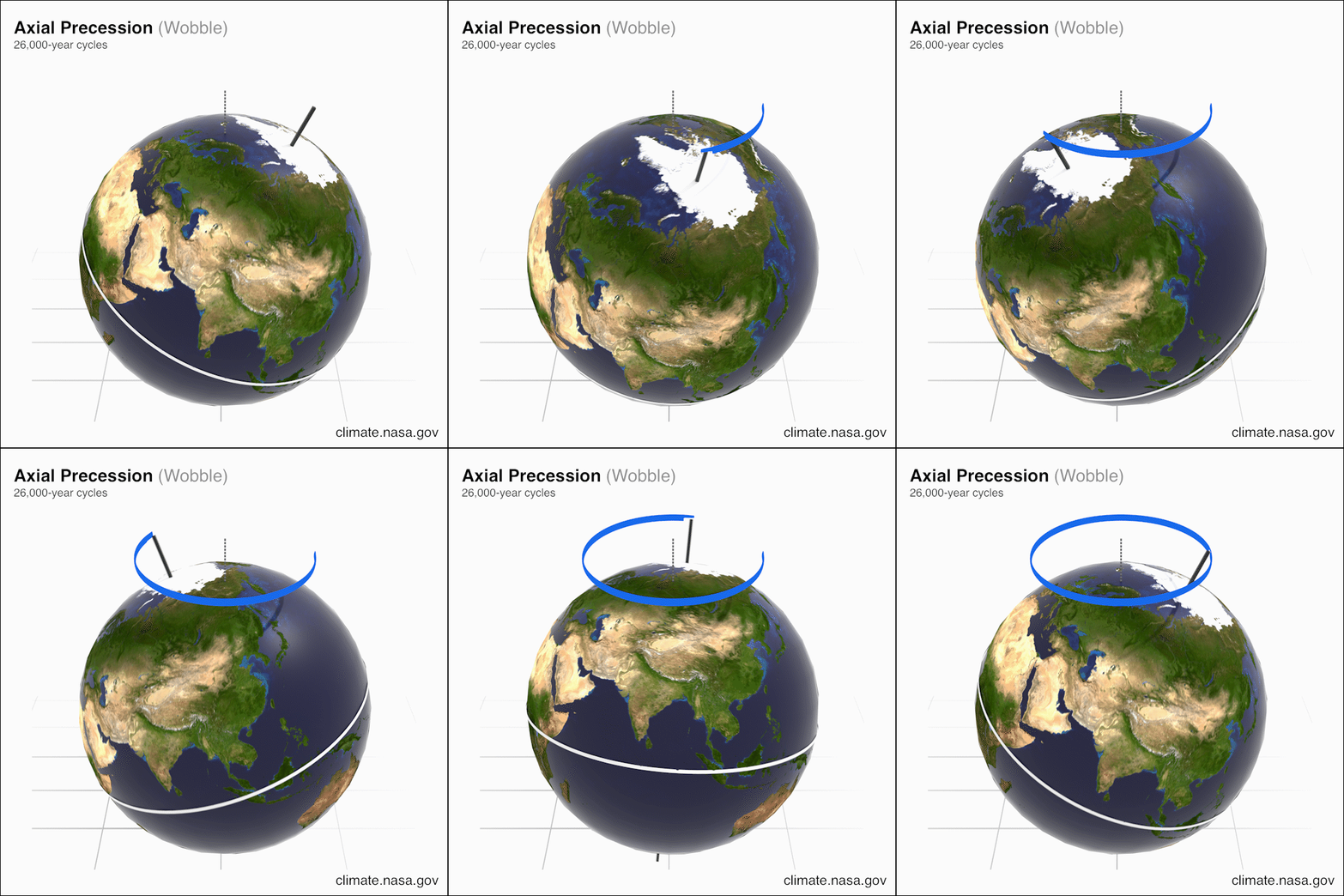
NASA describes the third factor
As Earth rotates, it wobbles slightly upon its axis, like a slightly off-center spinning toy top. This wobble is due to tidal forces caused by the gravitational influences of the Sun and Moon that cause Earth to bulge at the equator, affecting its rotation. The trend in the direction of this wobble relative to the fixed positions of stars is known as axial precession. The cycle of axial precession spans about 25,771.5 years.
Axial precession makes seasonal contrasts more extreme in one hemisphere and less extreme in the other. Currently perihelion occurs during winter in the Northern Hemisphere and in summer in the Southern Hemisphere. This makes Southern Hemisphere summers hotter and moderates Northern Hemisphere seasonal variations. But in about 13,000 years, axial precession will cause these conditions to flip, with the Northern Hemisphere seeing more extremes in solar radiation and the Southern Hemisphere experiencing more moderate seasonal variations.
A fourth factor relates to the Sun, which has its own cycles of greater or lesser radiance. We discovered the cycles 250 years ago and have charted 24 eleven year cycles of greater or lesser sunspots, a high number of which indicate increased radiation. We find they affect Mars and Saturn just as they do Earth, but they are not considered in climate models. It should be obvious that mankind’s role in determining the Earth’s temperature is somewhere between insignificant and zero.
How You Can Help
Holding policymakers accountable for harmful decisions is essential to ensuring transparency and fostering trust in our institutions. By supporting accountability measures, we create pressure for better governance and evidence-based policy making.
Find and promote Canadians worth supporting.
This is an unpopular issue, but one with huge follow-through. Staying informed about climate science policy ensures you understand the real stakes and can cut through misinformation. Knowledge is power when it comes to driving meaningful action.
Maybe we can help.
Engaging directly with businesses, institutions, and community leaders amplifies the call for a better future. Your voice as a constituent, customer, or community member carries weight in driving organizational change.
Engage with some fellow pathfinders.
Working within your political party to push for better policy creates change from the inside. Party members who advocate for evidence-based climate action help shift the conversation and influence platform decisions.
Help us hold the line.
Questions From Climate Skeptics
Have a different question and can’t find the answer you’re looking for? Reach out to us by sending us an email and we’ll get back to you as soon as we can.
- Can we forecast climate?
Not accurately, models make assumptions about a complex system so their forecasts remain unreliable at this time.
Learn more- Do we need to worry about carbon dioxide?
Maybe, but carbon dioxide being mostly plant food. Calling it 'carbon pollution' is political and not scientifically based.
Learn more- Can we afford the policies proposed by climate alarmists?
No, the costs would be trillions of dollars for Canada to impose current proposals with a possible net-negative environmental impact.
Learn more- Adaptation, Prosperity, and Environmental Stewardship
Given the uncertainty of climate science and the unsoundest of proposed migrations, it our responsibility to demand accountability.
Learn more- Do most climate experts agree that we face a climate crisis?
Some certainly do, but there remains a wide range of scientific analysis about the causes and consequences of climate change.
Learn more